The Service
What is well log certification?
Well log certification is the technical process of recovering, digitizing and validating historical well logs so they meet modern oil industry standards. Through rasterization and vectorization of the original documents, we transform curves on paper, film or microfilm into precise, editable digital data.
A certified log guarantees that the subsurface information is faithful to the original record, free of digitization errors, and can be used with confidence in petrophysical evaluations, geological models and investment decisions.
The Challenge
Legacy well logs frequently present multiple problems that make them unusable for modern studies:
- 01Physical deterioration and stains on original documents
- 02Illegibility of curves and annotations
- 03Obsolete tool nomenclature
- 04Incorrect or non-standard scales
- 05Missing or incomplete sections
- 06Depth mismatch between runs
- 07Errors in headers and metadata
- 08Previous digitization issues
The Process
From physical document to certified data
Rasterization
High-resolution digitization of logs on paper, film or microfilm, preserving every detail of the original document.
Vectorization
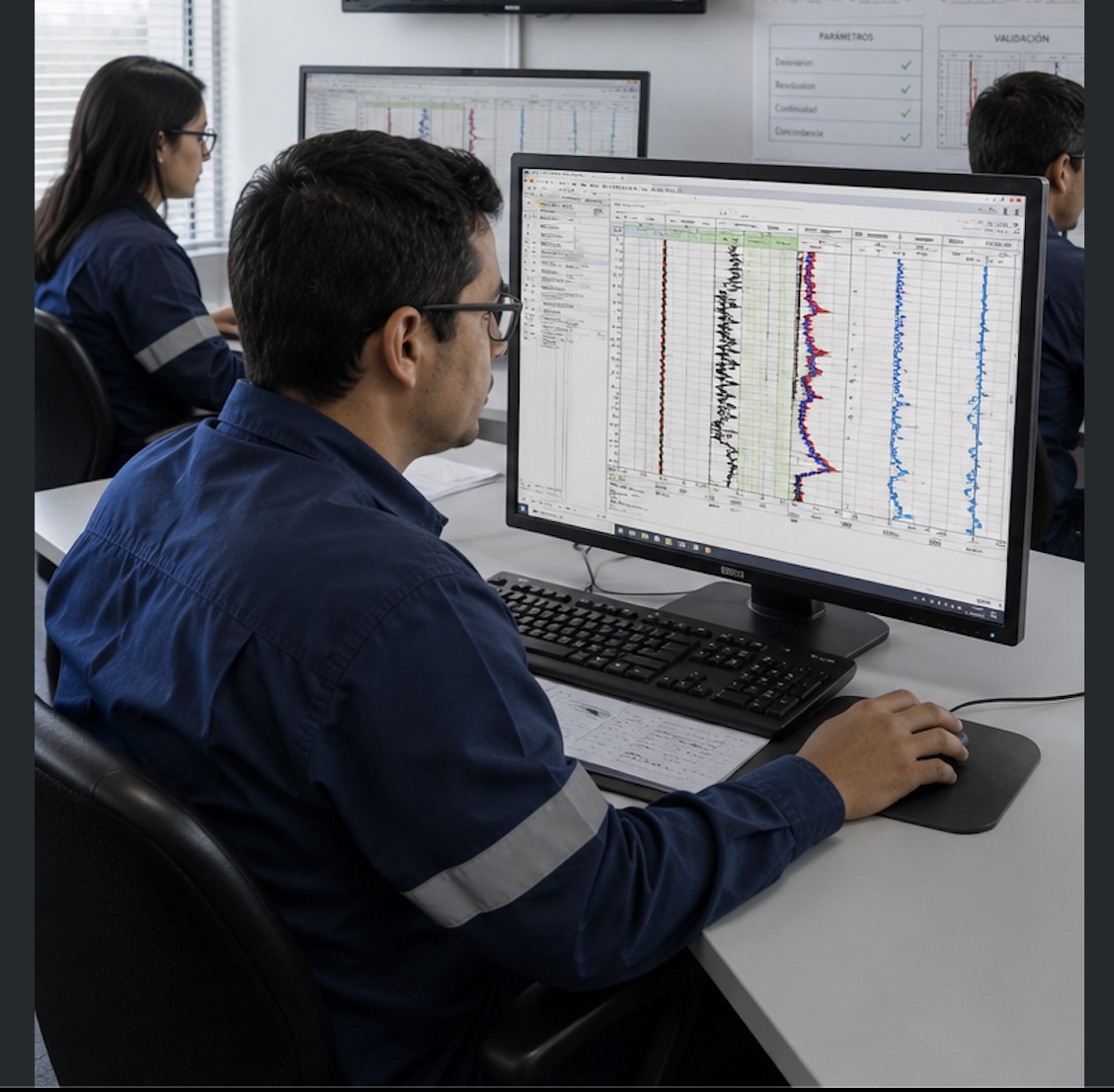
Conversion of raster curves into editable numeric data, with depth, scale and nomenclature control.
QA/QC Validation
Curve-by-curve validation against the original source to guarantee data traceability and strict compliance with technical and geological acceptance ranges.
Certification
Issuance of the certified log in .LAS format, with a technical report documenting the process and guaranteeing data traceability.
Reconstruction Methodology
A meticulous process combining historical technical knowledge with modern technology
- 01
Search and Analysis
Exhaustive analysis of legacy documents, reference wells, and drilling reports.
- 02
Specialized Knowledge
Application of knowledge regarding legacy tools and conversion of obsolete units.
- 03
Technical Validation
Verification against modern petrophysical standards and acceptance criteria.
- 04
Run Integration
Fusion of multiple runs into a continuous and coherent log.
- 05
Certified Delivery
Generation of the reconstructed and certified log, ready for operational use.
Why it matters
Investment decisions backed by certified data
Auditable data
Every certified log is traceable back to its original source and can be defended before partners, auditors and investors.
Savings vs. new acquisition
Certifying existing logs costs a fraction of the price of drilling, recompleting or re-logging a well.
Industry standard
Logs are delivered in LAS format, compatible with all modern petrophysical and modeling software.
Preserved technical heritage
We recover decades of subsurface information that would otherwise be lost to paper deterioration.
Results
Deliverables
Complete documentation and files ready for operational use
.LAS Files (Log ASCII Standard)
Continuous curves in the format most widely used in the industry today for integrity and reliability.
Digital Documents
Clean and organized images of original logs.
Technical Diagrams
Visualization of runs, intervals, and splices.
Technical Report
Complete documentation of the process and results.
Frequently Asked Questions
Frequently asked questions about well log certification
What is the difference between rasterization and vectorization?
Rasterization digitizes the document as a high-resolution image; vectorization converts those images into editable numeric data curves that can be exported to LAS format.
Which logs can be certified?
We certify well logs from any era, including logs on paper, film or microfilm from the 1920s to the 1980s, as well as low-quality previous digitizations.
In what format are certified logs delivered?
Logs are delivered in the industry-standard LAS format, accompanied by the digital images and a technical certification report.
How much does certifying a log cost compared to acquiring new data?
Reconstructing and certifying existing logs (6–8 curves per well) costs approximately 5% of acquiring new information through wireline service companies, considering the minimum acquisition package (typically 3 curves), provided the well's operational conditions allow the service to be performed. Other alternatives for obtaining petrophysical information are significantly more expensive.